
Last updated November 17, 2026
 Wrought iron
 Wood & steel frame
 Farm & ranch
 Sliding driveway gates
 LiftMaster operators
Free on-site gate assessment - hinges, posts, and your LiftMaster or Nice gate operator checked before anything is quoted
The assessment is free and the quote is the invoice.
Get your free estimateHow Long Does Gate Parts & Welding Take? Timelines and What to Expect
Welding a cracked hinge plate is a 20-minute job. Booking that job with a shop that squeezes residential gate calls between larger commercial contracts can take two weeks, and that gap between repair time and job time is where most homeowners get surprised. In Summerlin, where we spend most of our working hours, we’ve watched a homeowner wait eleven days for a hinge repair that took nineteen minutes under the torch. This guide breaks down what actually takes how long, from a four-hour weld-and-cure to a three-week custom fabrication, so you can ask the right scheduling questions before you commit. What follows are honest timelines for the work we do every week.
Quick Answer
Most gate welding and parts repairs take 1 to 3 hours of actual work, but the full job usually runs 3 to 6 hours once you add travel, cool-down, finishing, and touch-up. Simple hinge repairs can wrap in under two hours; post resets with new concrete need 72 hours before the gate goes back on. Custom fabrication is the wildcard: if a replacement part has to be made rather than sourced, expect 5 to 15 business days.
Styles & brands we work with
- Wrought iron
- Wood & steel frame
- Farm & ranch
- Sliding driveway gates
- LiftMaster operators
Table of Contents
- Repair Time vs. Job Time: The Difference Nobody Explains
- Realistic Timelines for Common Welding and Parts Jobs
- When Parts Have to Be Made, Not Sourced
- Post Reset and Concrete Curing: The 72-Hour Rule
- How Summerlin’s Climate Affects Welding and Cure Times
- Scheduling: Why the Shop’s Calendar Matters More Than the Work
- What “Done Right” Looks Like When the Technician Leaves
- Permits, HOA Approval, and Other Time You Can’t Skip
Repair Time vs. Job Time: The Difference Nobody Explains
When a welder quotes you “about 45 minutes,” they mean torch time. They are not including the drive across the valley, the setup, the cool-down, the grinding and finishing, the primer and paint touch-up, or the walk-through at the end. Add those and 45 minutes becomes 3 to 4 hours. This is not dishonesty; it’s shorthand. But it’s why so many Summerlin homeowners call us frustrated that a “quick repair” swallowed an afternoon.
Here’s how the time actually breaks down on a typical Summerlin gate call:
- Travel and site setup: 30 to 60 minutes. The gate has to be supported, power to the operator isolated, and the work area made safe.
- Diagnosis and confirmation: 15 to 30 minutes. What looks like a hinge failure is often a settled post or a warped frame; we confirm the actual cause before cutting.
- Welding or parts replacement: 20 minutes to 2 hours, depending on the job.
- Cool-down and grinding: 20 to 45 minutes. Welds must cool before they’re dressed; grinding hot metal warps the frame.
- Finishing and paint touch-up: 20 to 30 minutes. Bare steel rusts fast in Nevada’s dry air, so we prime and paint the same visit.
- Function test and homeowner walk-through: 15 to 30 minutes. Swing, clearance, latch, and operator alignment get confirmed before we leave.
That adds up to 2 to 4.5 hours for a job the torch touched for half an hour. It’s why we quote the job, not the weld.
Realistic Timelines for Common Welding and Parts Jobs
Below are the timelines we quote in Summerlin for the jobs we see most. These assume parts are on hand and the gate is accessible. If a part has to be ordered or fabricated, add the sourcing time described further down.
- Hinge repair or replacement: 1.5 to 3 hours total. The weld is quick; aligning the gate so it swings true takes the time.
- Frame corner re-weld: 2 to 3.5 hours. Corners bear the most stress, so they’re cleaned, welded, ground, and refinished to prevent recurrence.
- Drop rod or cane bolt replacement: 1 to 2 hours. Often the simplest job on the list; hardware sizing is the only complication.
- Full gate panel replacement: 4 to 8 hours, sometimes two visits. Removal, hanging, alignment, and any operator re-tuning all factor in.
- Post reset with new concrete: 2 to 4 hours active work, then a 72-hour wait before the gate is rehung or re-automated.
- Track repair or roller replacement: 1.5 to 3 hours. Sliding gates need the track plumb and level; small tolerances matter.
Notice how many of these are two-hour jobs quoted as half-day visits. That’s honest scheduling, not padding. And sometimes the fix is a parts job we can handle on the spot and sometimes it needs a proper look first – which is why we start with gate repair in Summerlin diagnostics before anyone picks up a torch.
When Parts Have to Be Made, Not Sourced
Most gate parts are catalog items: hinges, rollers, latches, drop rods, and operator arms for LiftMaster, FAAC, and Ghost Controls systems all come off a shelf. Some don’t. Older estate gates in Summerlin, particularly wrought-iron and forged-steel designs from the 1980s and 1990s, often use hardware sizes and profiles nobody stocks anymore. When that happens, the shop has to make the part.
Custom fabrication follows a predictable arc:
- Measure and template: 1 visit, 45 to 90 minutes. The technician records the gate’s dimensions, metal thickness, and mounting geometry.
- Shop drawing and material pickup: 2 to 5 business days. Steel gets ordered in the correct gauge and profile.
- Fabrication: 2 to 4 business days for a single bracket or hinge piece; 5 to 10 for a full stile or corner section.
- Finishing: 1 to 2 days. Primer, paint, or powder coat, and that cure time is non-negotiable.
- Installation: 1 to 2 hours on site, back on the original schedule.
Total: 5 to 15 business days, usually landing around 7 to 10. In our experience, maybe one job in six needs any fabrication at all. When it’s avoidable, it’s avoidable because a compatible modern substitute exists; when it’s not, forcing a substitute is how gates come back a year later with a cracked weld right beside the new part.
Post Reset and Concrete Curing: The 72-Hour Rule
A post reset is the one job where the timeline is dictated by chemistry, not craft. New concrete needs time to reach even partial strength, and a gate hung too early leans, sags, or cracks the fresh footing. Our rule in Summerlin is simple: no rehanging and no re-automation for at least 72 hours after the post is set. For heavy gates or posts over six feet, we recommend 7 days before the operator goes back into service.
What that 72 hours looks like:
- Hour 0 to 24: Concrete sets but is not load-bearing. Gate stays off the post entirely.
- Hour 24 to 48: Partial strength. Still no gate weight; the post should not be leaned against, bumped, or tested.
- Hour 48 to 72: Approaching working strength. We prefer to wait the full window before hanging a gate.
- Day 3 onward: Rehang, realign hinges, retune the operator.
- Day 7 to 28: Full cure. Minor settling is normal; significant movement means the footing or the setting was wrong.
In summer, Summerlin’s concrete can dry too fast and cure weak. We cover fresh footings against direct sun and check moisture before we leave. In winter, cool nights slow the cure, and 72 hours can become 4 days. That’s part of why we quote the wait, not the work, before we start.
How Summerlin’s Climate Affects Welding and Cure Times
Summerlin sits at elevation in the Mojave, and the desert changes the working timeline in ways coastal shops don’t account for. Summer surface temps on exposed steel gates regularly exceed 140°F in the afternoon sun. Welding hot steel already at that temperature warps faster, so we schedule most welding in the morning.
Cold matters too. Winter mornings in Summerlin routinely drop into the 30s, and welding cold steel without preheating can create hairline cracks invisible until months later. We preheat on cold mornings. Paint and primer also need a window: below 50°F, paint doesn’t cure properly, so finishing gets pushed to midday.
And then there’s dust. Summerlin gets wind-borne dust that settles into fresh welds before the primer goes on. That’s why we brush, clean, and prime the same visit rather than leaving bare metal between jobs. The gate that rusts is usually the gate that waited.
When the operator is part of the problem, climate affects automation just as much. Heat alone can cause a LiftMaster or Elite board to fault – if that’s your issue, our page on gate motor & opener in Summerlin covers the diagnosis side.
Scheduling: Why the Shop’s Calendar Matters More Than the Work
Here’s the insight that unlocks everything else in this guide: the part of a welding job that takes longest is almost never the welding. It’s the shop’s calendar. A general contractor running commercial jobs between residential calls may quote “one to two weeks” because the residential job fills a crack in their schedule; you’re waiting on their priorities, not the work itself.
What to ask before you book:
- “Is gate welding and repair your primary service, or a side job?” A dedicated gate company gets to you faster because you’re not fitting around someone else’s commercial calendar.
- “When did you last perform this exact repair?” A shop that welds gate frames weekly will be faster and cleaner than one that does it monthly.
- “Are parts on hand, or do we have to order them?” This single question determines whether your job is a 3-hour visit or a 2-week wait.
- “What’s your no-show rate?” Any company worth hiring can tell you. We’re in Summerlin and we plan to be here another forty years; our reputation is the whole business.
We schedule most Summerlin welding and parts calls within a week, and we tell you on the call whether we’re booking 2 days out or 10. Live phone support answers every time, 24 hours a day. If you’re not sure whether yours is a repair or an install, our overview page on the Summerlin home base for Ironworks Gate Co. walks through the full service scope.
What “Done Right” Looks Like When the Technician Leaves
A welding job is finished when a qualified inspector, one you trust, signs off. That means you should walk the gate with the technician before they pack up. Not a glance from the doorway. An actual inspection.
- Weld appearance: Beads should be even, full, and free of slag or porosity. Dressed welds should be ground smooth, not left rough.
- Paint and primer: Every welded area should be primed and top-coated before the technician leaves. Bare steel is a future rust spot.
- Swing or slide quality: The gate should move without binding, drift, or scraping. If it does, the alignment wasn’t finished.
- Latch and hardware: Latch, drop rod, or cane bolt engaged cleanly without force. Hinges tight. Fasteners flush.
- Operator function (if automated): Full open and close cycle, safety sensors tested, manual release tested.
- Cleanup: Metal dust, grinding debris, and packaging removed. Your driveway should not look like a shop floor.
- Written confirmation: Every completed job leaves with the Ironworks Gate Co. 90-Day Done Right Promise in writing – if anything we touched isn’t right, we come back and make it right, on every job, no arguing.
If a technician can’t walk through all seven with you, the job isn’t done. For a full install, the checklist looks different and the timeline is measured in days of planning, not hours of work – see gate installation in Summerlin for what that looks like.
Permits, HOA Approval, and Other Time You Can’t Skip
Summerlin’s gate work also runs through a paper trail that adds weeks to any install or panel replacement, and occasionally to a repair that changes the gate’s footprint. Summerlin is under the Clark County building department for structural work, but individual HOA covenants vary by village, and some Summerlin communities require architectural review before a gate is replaced or its color, height, or style is changed. That review can take 10 to 30 calendar days, depending on the community’s board schedule.
Where permits or HOA approval are required, the timeline is:
- Application submission: 1 to 3 days, once the design is set.
- HOA architectural review: 10 to 30 calendar days.
- Clark County permit (structural work only): 5 to 15 business days for typical residential projects.
- Work scheduling: 1 to 3 days after approval, materials permitting.
Repairs to existing gates almost never require permits. Replacements and new installations frequently do. A good gate company tells you upfront which category your job falls into, rather than discovering it after the panel has been ordered.
Common Mistakes to Avoid
- Believing a phone estimate gives you a real date. On-site assessment is the only way to know if a job is 2 hours or a 2-week fabrication wait. Ask for the on-site date, not the phone estimate date.
- Rehanging a gate too soon after a post reset. We’ve seen Summerlin gates come back within a month because a homeowner (or an impatient contractor) hung the gate at 24 hours. The concrete wasn’t the problem; the timing was.
- Painting over bare steel without primer. Primer first, always. In Summerlin’s dry air, the rust appears within a couple of months and the weld is the first place it starts.
- Accepting a substitute part that doesn’t match the gate’s geometry. If the shop says “this hinge is close enough,” ask them to test the swing before they leave. Close enough is how gate frames crack.
- Letting a fabricated part go unfinished. Ordering a custom bracket is fine, but the finishing schedule (primer, paint, cure) is not optional. Bare custom work will rust before the warranty runs out.
- Skipping the walk-through. If the technician leaves without a checklist inspection, you’re inspecting it alone, without the leverage of a warranty conversation in real time.
- Ignoring HOA review on Summerlin replacements. Ten to thirty days of HOA review has a way of sitting dormant until the panel arrives. Start the paperwork with the material order, not after.
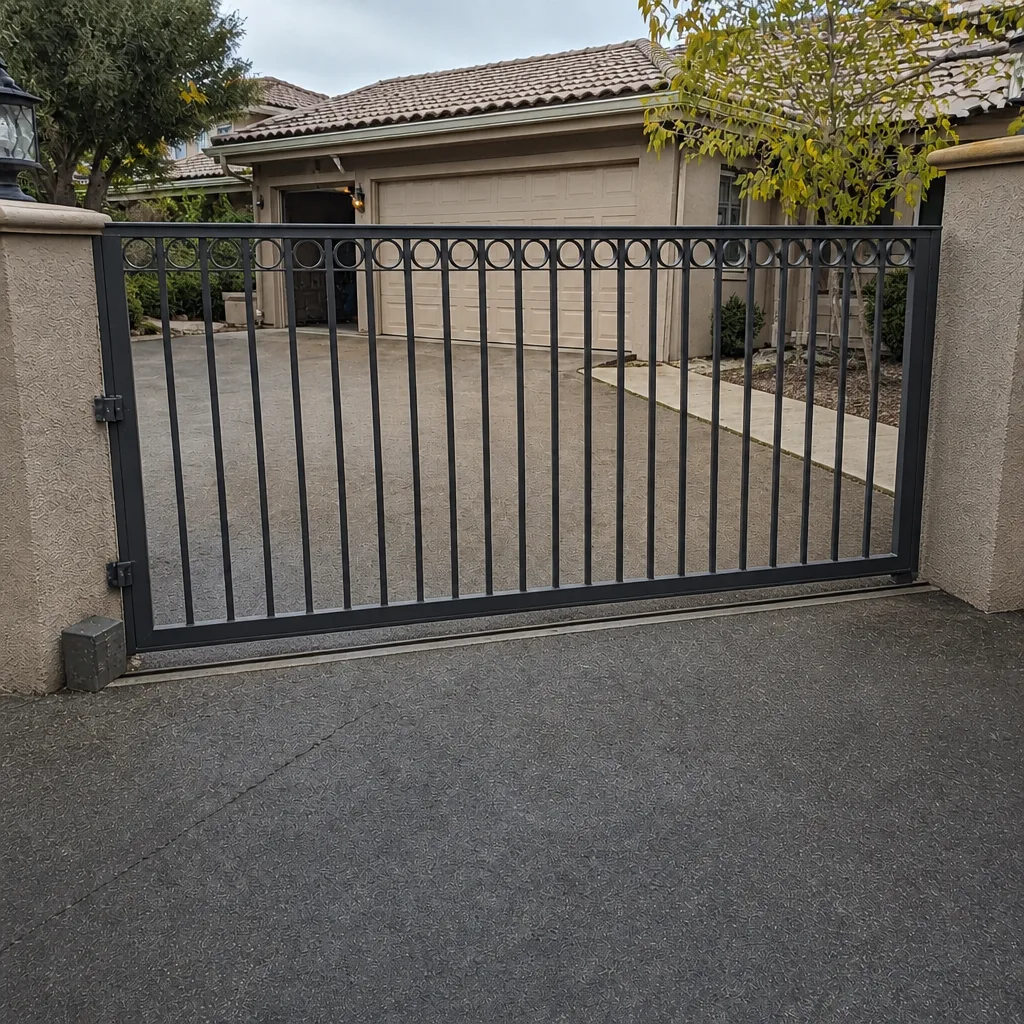
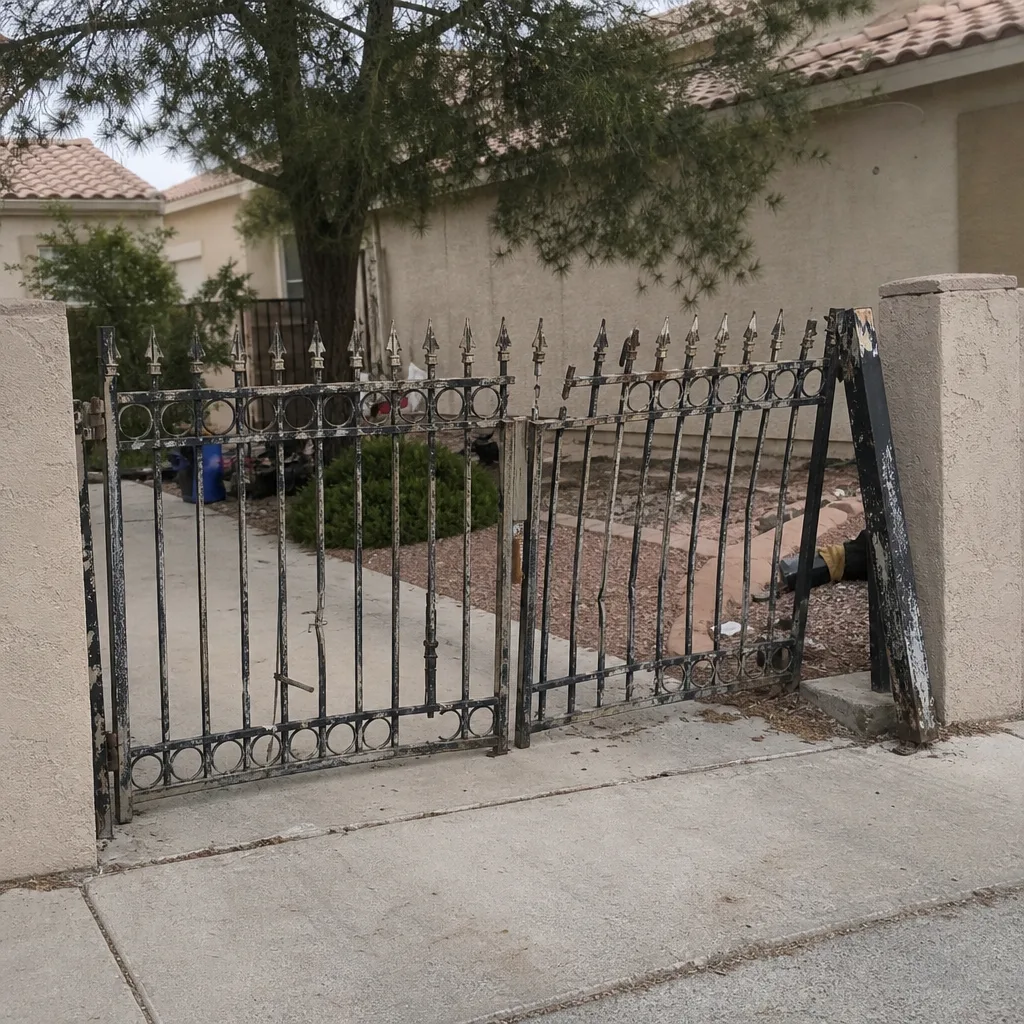
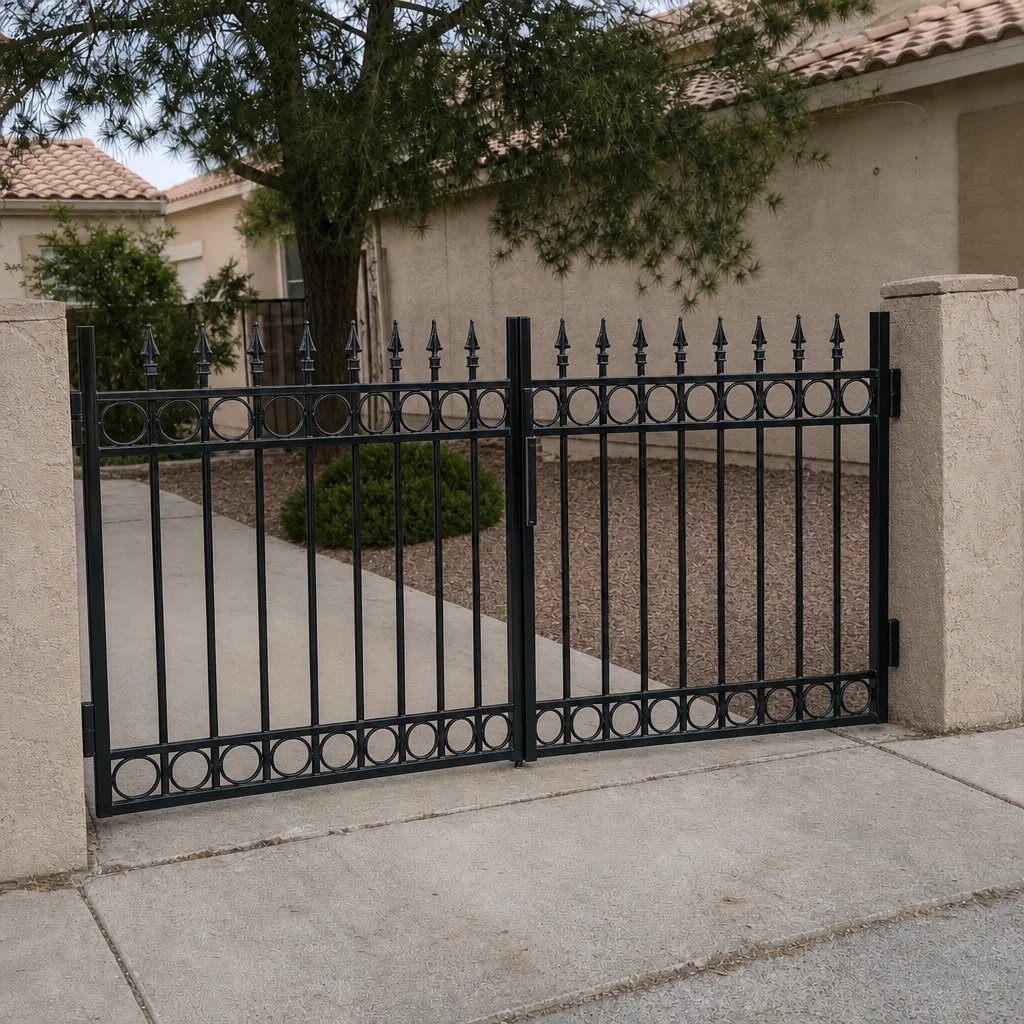
See the difference
 Before
 After
 Before
 After
 Before
 After
When to Call a Professional
Call a professional for any welding or gate structure work that involves the gate’s load path – hinges, corners, posts, frames, drop rods. Welding is hot work around loaded steel, and a failed weld under a gate’s weight can take the whole assembly down. Call also if the gate is automated and needs retuning around a repair, or if the gate has a post reset on the schedule (a fresh concrete job under an automated gate is a specific skill set). If your gate is a Ghost Controls, DoorKing, Elite, or Viking system, a technician trained on the brand makes the fix right the first time.
If you’re unsure whether your job is a welding call or an operator call, we’re happy to help sort it out before you book. Ironworks Gate Co. Summerlin offers free estimates in Summerlin – call (866) 623-9848.
Frequently Asked Questions
Most gate welding repairs in Summerlin take 1 to 3 hours of actual welding plus 1 to 3 hours of travel, cool-down, finishing, and touch-up, for a total of 2 to 6 hours on site. Hinge repairs and drop rod replacements fall on the shorter end; frame corner re-welds and panel replacements sit on the longer end. Call (866) 623-9848 for an exact quote – estimates are free.
Sometimes, yes. Same-day welding availability depends on parts, weather, and the shop’s schedule; we tell you on the call rather than promising a time we can’t hold. Jobs that need fabrication or a post reset with fresh concrete are always scheduled, never same-day, because the work itself requires a curing window. Call (866) 623-9848 and we’ll give you a real answer, not a maybe.
Wait a minimum of 72 hours after the concrete is poured, and 7 days is safer for heavy gates or posts over six feet. Rehanging or re-automating early can crack the fresh footing and leave the gate permanently misaligned. We always tell Summerlin homeowners the exact wait before we pour. Call (866) 623-9848 if you’re not sure whether your footing is ready.
A gate part has to be fabricated when no compatible modern part matches its dimensions or profile – common on wrought-iron and older forged-steel gates in Summerlin. Fabrication adds 5 to 15 business days, with 7 to 10 typical. Your technician can tell you on the first visit whether fabrication is avoidable. Call (866) 623-9848 for a free second opinion on any written estimate.
Inspect the weld finish, the primer and paint, the swing or slide, the latch and hardware, operator function if automated, and the cleanup. Seven things, walked through with the technician present, not after they’ve left. If the checklist doesn’t pass, the job isn’t finished. Call (866) 623-9848 to discuss what “done right” means on your specific gate.
Yes, Summerlin’s climate changes the schedule in two places: heat and cold. Welding runs in the morning during summer to avoid warping pre-heated steel, and paint and primer need a midday window when winter temperatures drop below 50°F. A job that would take 3 hours in mild weather can take 4 to 5 hours in extreme heat or cold. Call (866) 623-9848 for a schedule that accounts for the season.
The Bottom Line
Gate welding and parts work is fast; scheduling it isn’t. Actual repair time runs 1 to 3 hours for most jobs, and full on-site time runs 3 to 6 hours once you count travel, cool-down, finishing, and touch-up. Post resets add a mandatory 72-hour curing wait. Custom fabrication adds 5 to 15 business days. Permits and HOA review – Summerlin-relevant – add 10 to 30 calendar days for replacements. The gate that lasts is the one where the timeline was honored, not shortcut. Done right, backed in writing.
If your gate is cracked, sagging, sticking, or you’re not sure what it needs, call (866) 623-9848 for a free estimate. A live person answers every call, 24 hours a day, and our technicians – trained on nine leading brands – will give you an honest timeline and an upfront price before a single bolt is turned. Every job leaves with the 90-Day Done Right Promise in writing.
Written by the team at Ironworks Gate Co. Summerlin.