
Last updated November 17, 2026
 Wrought iron
 Wood & steel frame
 Farm & ranch
 Sliding driveway gates
 LiftMaster operators
Free on-site gate assessment - hinges, posts, and your LiftMaster or Nice gate operator checked before anything is quoted
The assessment is free and the quote is the invoice.
Get your free estimateDIY vs Professional Gate Motor & Opener: What’s Safe to Do Yourself
Reprogramming a remote is a ten-minute job any homeowner can finish before the coffee goes cold. Adjusting the travel limits on a high-torque slide operator is a different animal: a miscalibration there can shear a hinge post, crush a fender, or leave a gate cycling with enough stored force to hurt someone. Both jobs look equally approachable in a YouTube video, and that’s the trap. This guide draws the line honestly. We’ll separate the duties that are genuinely owner-safe from the ones that carry consequences outlasting the afternoon, explain how manufacturer warranties actually handle DIY wiring, and give you a cost-benefit framework for the Summerlin homes we work on every week.
Quick Answer
Safe to do yourself: pairing remotes and keypad codes, swapping backup batteries, cleaning and realigning photo-eye sensors, and clearing debris from the track. Leave to a technician: limit and force adjustment, control board replacement, motor mounting, low-voltage wiring, and loop detector tuning. On swing and slide gates, those tasks involve hundreds of pounds of stored mechanical energy, high-torque springs, and warranty terms that most homeowners never read until something breaks.
Styles & brands we work with
- Wrought iron
- Wood & steel frame
- Farm & ranch
- Sliding driveway gates
- LiftMaster operators
Table of Contents
- The Two-Column Rule: Owner-Safe vs Technician-Only
- Why Limit and Force Adjustment Is the Most Dangerous DIY Task
- The Warranty Trap: What Most Installers Won’t Tell You
- The “I Watched a Video” Scenario
- Cost-Benefit: A Tune-Up vs a Damaged Gate or Vehicle
- What’s Different About Gate Openers in Summerlin
- Brand Matters: Where DIY Is Easier and Where It Isn’t
- How to Verify a Technician Before You Call
The Two-Column Rule: Owner-Safe vs Technician-Only
We’ve serviced gate motors across Summerlin for years, and the questions we get at the counter tend to fall into the same two piles. Here’s the split we’d draw for a friend. If a task lives in the left column, grab a screwdriver and have at it. If it lives in the right column, put the tool down and make a call, because the risk of getting it wrong isn’t worth the money you save.
Owner-safe tasks
- Pairing a new remote to the receiver
- Changing the entry code on a keypad
- Replacing the backup battery (12V, usually behind a small panel on the operator housing)
- Cleaning the photo-eye lenses with a soft cloth and checking that the beam is unobstructed
- Clearing leaves, gravel, or debris from the gate track and rollers
- Resetting the operator after a power outage by cycling the power at the breaker
- Lubricating hinges and rollers with a light silicone spray (not grease, which collects desert dust)
Technician-only tasks
- Adjusting open and close travel limits
- Setting force or torque parameters on the control board
- Replacing or reprogramming a control board
- Mounting or remounting the motor itself
- Running new low-voltage or high-voltage wiring
- Tuning a loop detector or vehicle sensor
- Adjusting the safety reverse pressure
Notice that the safe list is all about configuration, cleaning, and consumables. The technician list is all about force, energy, and calibration. That distinction matters more than most homeowners realize, and it’s the reason we tell people to stop before they touch a limit screw. If you’re unsure which side of the line you’re on, our gate motor & opener service in Summerlin team can tell you over the phone in two minutes.
Why Limit and Force Adjustment Is the Most Dangerous DIY Task
Here’s what a gate opener actually does. It doesn’t lift a lightweight door; it pushes a panel that can weigh 300 to 600 pounds on a swing gate and more on a slide gate, and it does so with mechanical energy stored in springs, counterweights, and the motor itself. When the travel limit is set wrong, the operator keeps pushing after the gate has reached its stop. The result is a sheared hinge, a bent track, a cracked post, or a gate that closes with enough force to pin a child or a pet.
The force setting on the control board exists precisely to prevent that. Manufacturers typically recommend testing the reverse function with a 40-pound object placed at the gate’s edge, but most DIY adjustments skip that test because the video didn’t show it. We’ve walked onto Summerlin properties where the gate had been “adjusted” by the homeowner, and the reverse function was set so high that it would have crushed a bicycle without triggering. That isn’t a job for trial and error.
There’s also the spring and counterweight side. High-tension spring assemblies on swing gates store enough energy to cause serious injury, and unlike a garage door, the gate is often mounted to a masonry pillar where a sudden release can swing the panel sideways. This is one of the few places where we tell people plainly: don’t touch it. A trained technician has the tools, the load testing procedure, and the experience to set the limits correctly the first time.
The Warranty Trap: What Most Installers Won’t Tell You
Most major opener brands, including LiftMaster, Elite, and FAAC, condition their warranty coverage on professional installation of the wiring and mechanical components. In plain terms: if you run your own low-voltage wire or remount the motor yourself and something fails six months later, the manufacturer can decline the claim. This is buried in the paperwork, and it’s the consequence that hits homeowners in Summerlin hardest, because our climate accelerates wear on wiring and control boards. A board that fails after a DIY wiring job is a board you pay for yourself, often $200 to $400, plus labor.
How to verify what your warranty actually says:
- Find the model number on the operator housing (usually a sticker on the underside or side panel).
- Search the manufacturer’s site for the specific model’s warranty document, not the general brochure.
- Read the “Limitations” and “Exclusions” sections, which is where the professional-installation language lives.
- Check whether the warranty requires a certified installer for wiring, the motor itself, or both.
- Keep the installation invoice. Most claims require proof of professional installation.
If you’re already facing a warranty headache, we’re happy to read your paperwork with you. It’s a common reason people call our gate repair in Summerlin line, and there’s no charge for the second opinion.
The “I Watched a Video” Scenario
We’re not anti-video. Video tutorials have taught plenty of homeowners how to reset a keypad code or pair a Mighty Mule remote, and that’s genuinely useful. But we’ve seen enough of them to know what they consistently skip. Here’s the short list of what you won’t see on the screen:
- Load testing. After adjusting limits, the gate should be tested with a known-weight object. Videos rarely mention the 40-pound standard, and almost never show it being done.
- Torque spec verification. Motor mounting bolts are torqued to manufacturer specs. Hand-tight is not the same, and an under-torqued mount will work loose over a summer.
- Safety sensor positioning standards. Photo-eyes need to be mounted at the correct height and angle to detect a small child, not just an adult. Placement matters more than most tutorials let on.
- Battery and backup behavior. A gate that loses power mid-cycle needs to behave predictably. Videos rarely cover the fail-safe test.
- Rain and dust infiltration. Here in Summerlin, the monsoon season pushes grit into every seam. A mount that faces the wrong direction will fail faster.
The honest framing: a video teaches you the motion, not the calibration. If you’ve watched one and you’re still unsure whether the gate is closing with the right reverse pressure, that’s your signal to stop. We’ve written more on this in our Summerlin repair guide if you want the longer version.
Cost-Benefit: A Tune-Up vs a Damaged Gate or Vehicle
This is where a senior homeowner’s math usually settles the question. A seasonal tune-up, including limit verification, force testing, and lubrication, is a small, predictable number. A misadjusted opener is not.
- Professional tune-up: $89 (our standing seasonal rate) covers travel limit check, force testing, battery health, sensor alignment, and lubrication.
- Replacing a control board after a DIY error: often $200 to $400 in parts, plus labor.
- Replacing a sheared hinge post or bent track: $400 to $900 depending on the gate style, plus welding labor.
- Repairing a vehicle damaged by a gate that reversed late or not at all: commonly $1,200 to $4,000, and often a reluctant insurance claim.
- Injury to a child or pet: not a number we’d ever want to write down.
The tune-up costs less than a single oil change. The damage it prevents costs thousands. In the Summerlin market we’ve seen this play out dozens of times, and the homeowners who call us for the $89 tune-up are the ones who never end up on the wrong side of that arithmetic. If your repair does run past $250, we’ll take $50 off, because the offer stands. And if you have a written estimate from another company, we’ll give you a free second opinion before you commit.
What’s Different About Gate Openers in Summerlin
Summerlin’s climate is a mixed bag for gate automation, and it’s why we tell locals to treat annual service as routine. The summer heat pushes control board temperatures to the edge of their rated range, dust storms coat photo-eye lenses in a single afternoon, and the occasional winter freeze cracks older lead-acid backup batteries that were already near end of life. A gate that runs fine in April can fail to reverse in August.
There’s also the community angle. Homes in The Ridges, Red Rock Country Club, and Spanish Trail often sit behind HOA-managed walls, and some of those HOAs have specific requirements about gate operator noise, finish, and access control integration. That’s a conversation to have before a new opener goes in, not after. If you’re in one of those communities, our gate installation team in Summerlin can walk you through the HOA side of the equation as part of the free estimate. It’s the kind of local detail a national call center simply doesn’t have.
We’re a Summerlin home base for gate work and our technicians are background-checked, uniformed, and guided by a simple code: the 400th job on a street gets the same care as the first. That’s part of why we’ve been proud to serve local communities for over 42 years, and why our technicians have up to 13 years of experience on the brands that dominate Summerlin driveways.
Brand Matters: Where DIY Is Easier and Where It Isn’t
Not all openers are created equal when it comes to homeowner serviceability. Some brands give you a clear owner’s manual and a straightforward keypad code process. Others are locked behind dealer-only diagnostic tools.
Elite and Mighty Mule sit on the friendlier end. Their remotes and keypads are designed for owner setup, and basic battery swaps are documented in plain language. If you have one of these and only need to pair a remote, you’ll get it done. LiftMaster and FAAC lean more toward the certified-installer model, especially for board-level work and wiring, and their warranty language reflects that. If you’re not sure which brand you have, the model sticker is the place to start.
Our team is trained and equipped on nine major brands, including LiftMaster, FAAC, Elite, and Mighty Mule, so the correct fix gets made on the first visit regardless of what’s on your driveway. That matters on the professional side of the line. On the DIY side, a little knowledge of your brand tells you whether to pick up the phone or the remote.
How to Verify a Technician Before You Call
If you’re going to bring someone out, a few simple checks will save you a headache. We’d rather you vet us than trust the first van in your driveway.
- Ask whether they’re licensed and insured for gate work in Nevada, and ask them to put it in writing.
- Ask which brands they’re certified on. If your opener isn’t on the list, call someone who is.
- Ask for a written estimate before work starts. Upfront pricing is the standard, not the exception.
- Ask what the warranty or guarantee is on the completed job, and whether it covers the labor as well as the parts.
- Ask whether the technician is background-checked. Anyone working near your home should be.
Every job we complete is covered by our written 90-Day Done Right Promise: if it’s not right, we come back and make it right, no paperwork and no arguing. It’s a simple standard, and it’s the reason we don’t mind you asking hard questions up front.
Common Mistakes to Avoid
- Adjusting limits without a reverse test. A gate that closes “fine” can still fail to reverse on a 40-pound load, and in Summerlin that load is often a child on a bike.
- Running low-voltage wire yourself to save money. Most manufacturers condition the warranty on professional wiring, so the savings often disappear on the first board failure.
- Greasing the track instead of using silicone. In desert dust, heavy grease becomes a magnet for grit and wears the rollers faster.
- Ignoring photo-eye misalignment after a dust storm. A few degrees of drift is enough to make the gate open-and-stop all afternoon, and homeowners often assume the motor is failing.
- Skipping the annual tune-up because the gate is “working.” The failure we see most often in Summerlin is a control board that overheated in July and stopped reversing quietly, not loudly.
- Mounting a new opener without checking HOA rules. If you’re in The Ridges or another managed community, a non-compliant install can mean re-doing the job.
- Assuming a “click but no movement” means the motor is dead. It’s usually a battery, a capacitor, or a limit switch, and the diagnosis is cheaper than the part.
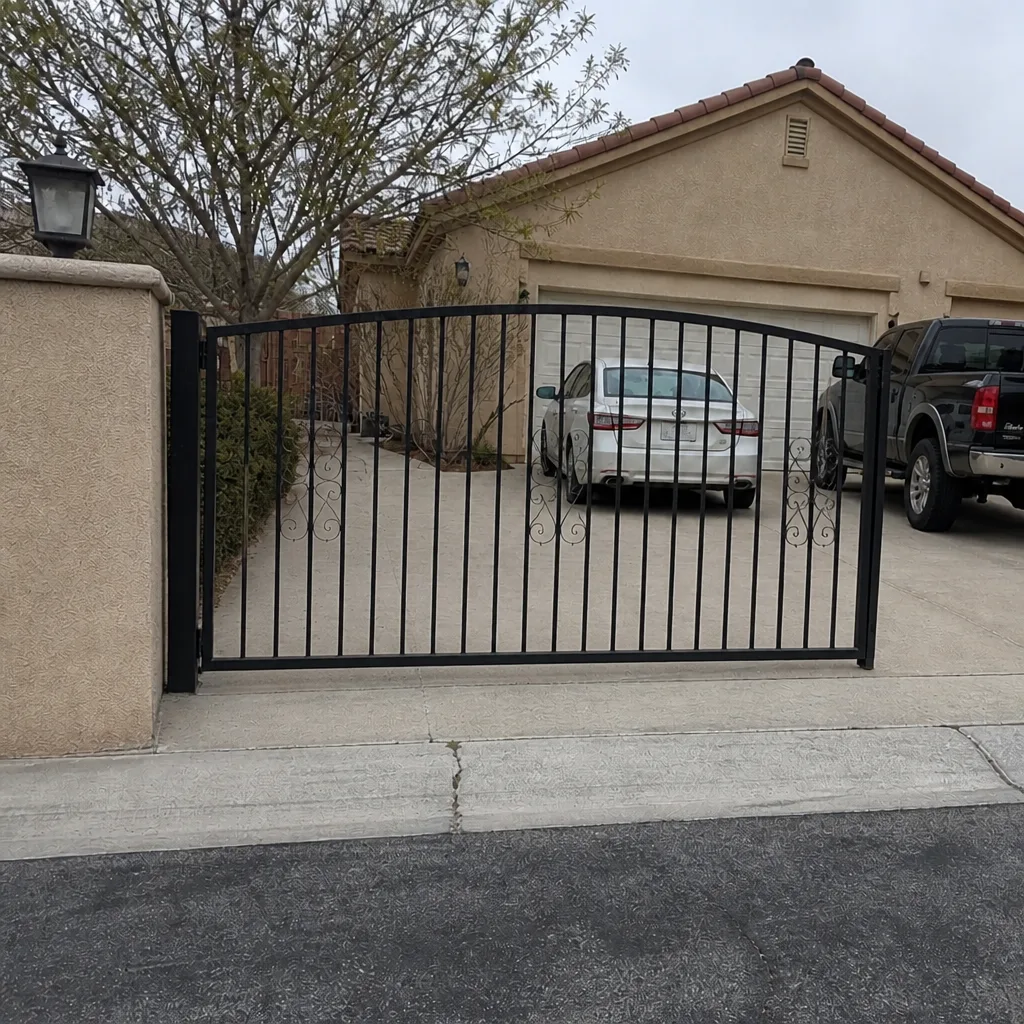
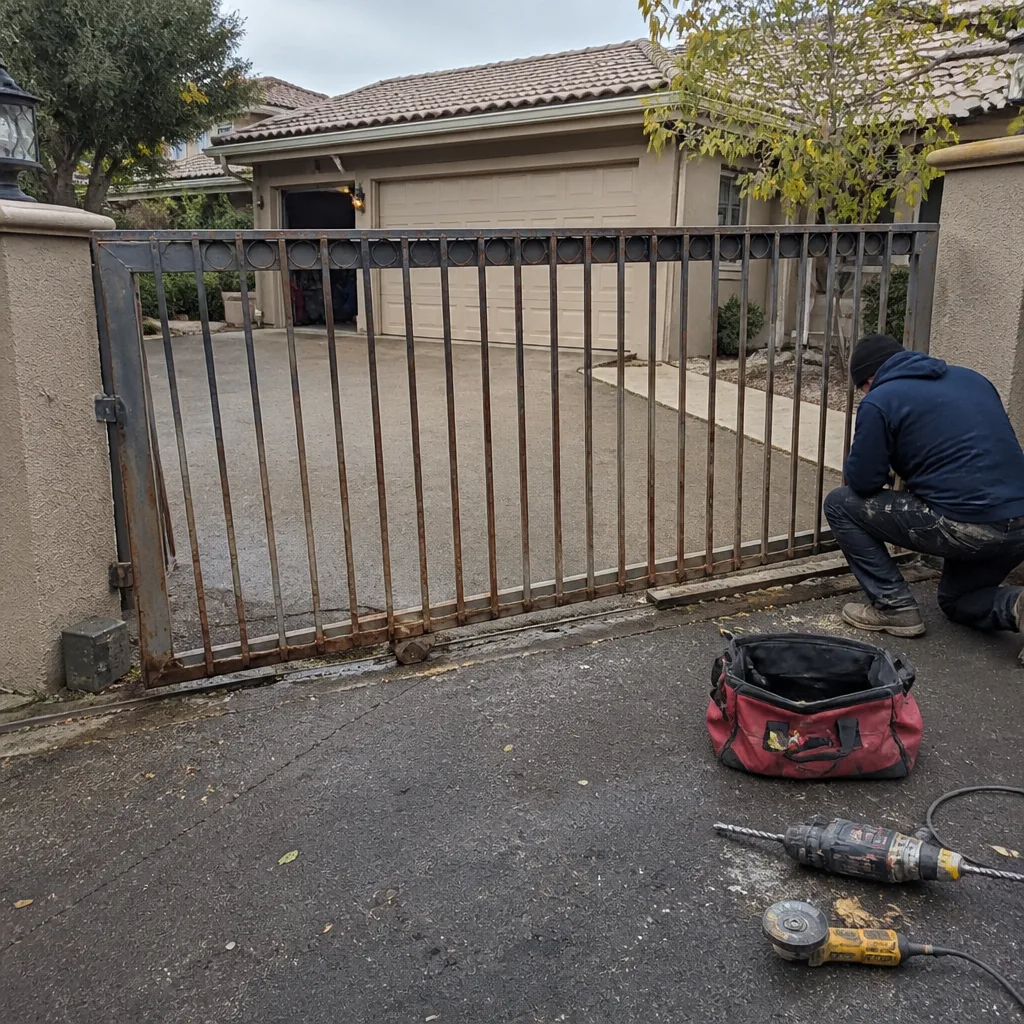
See the difference
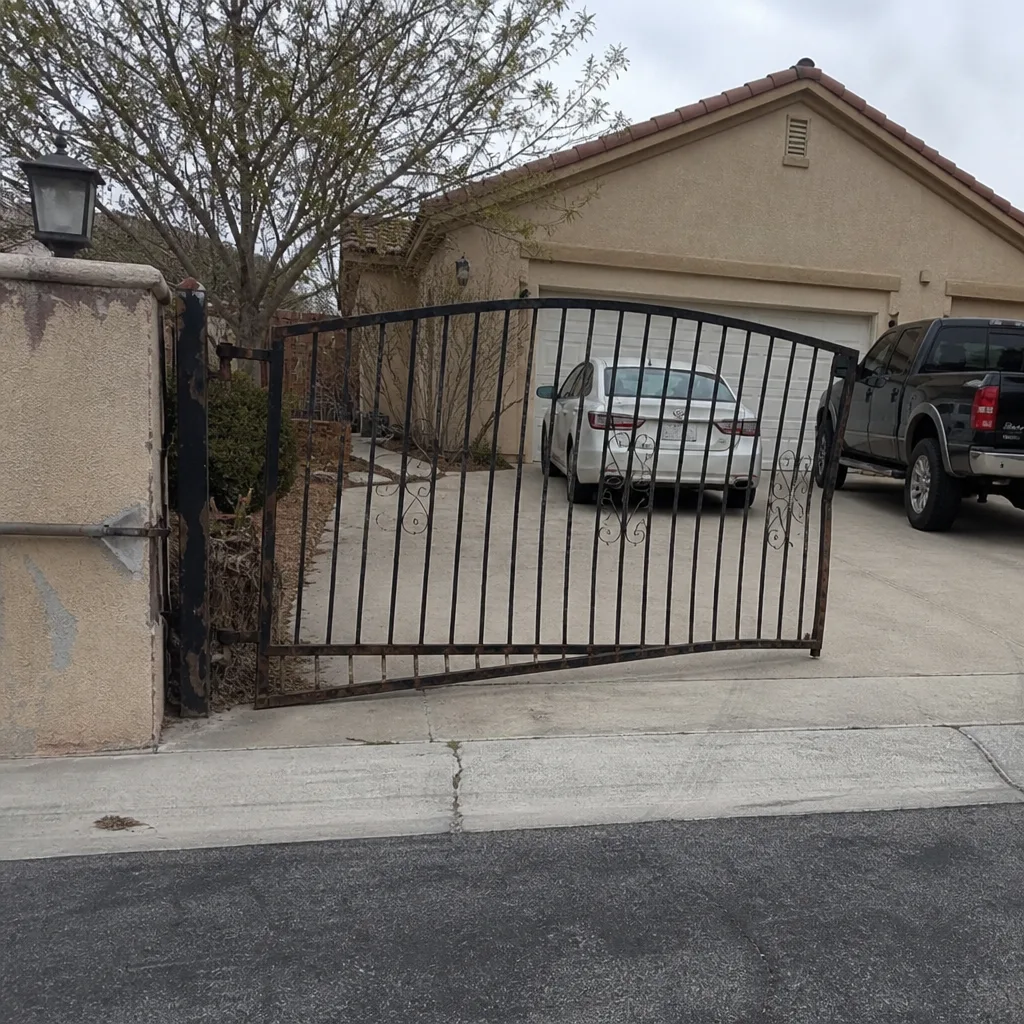 Before
 After
 Before
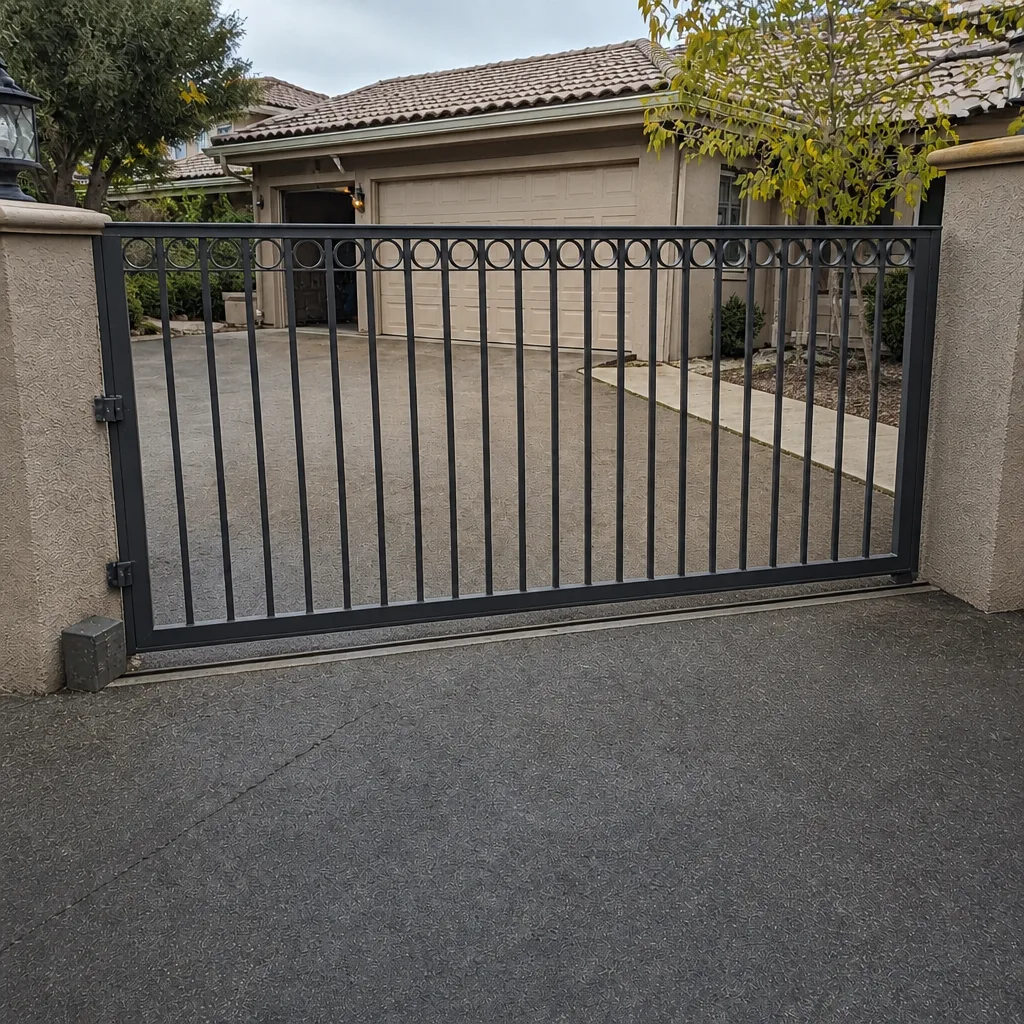 After
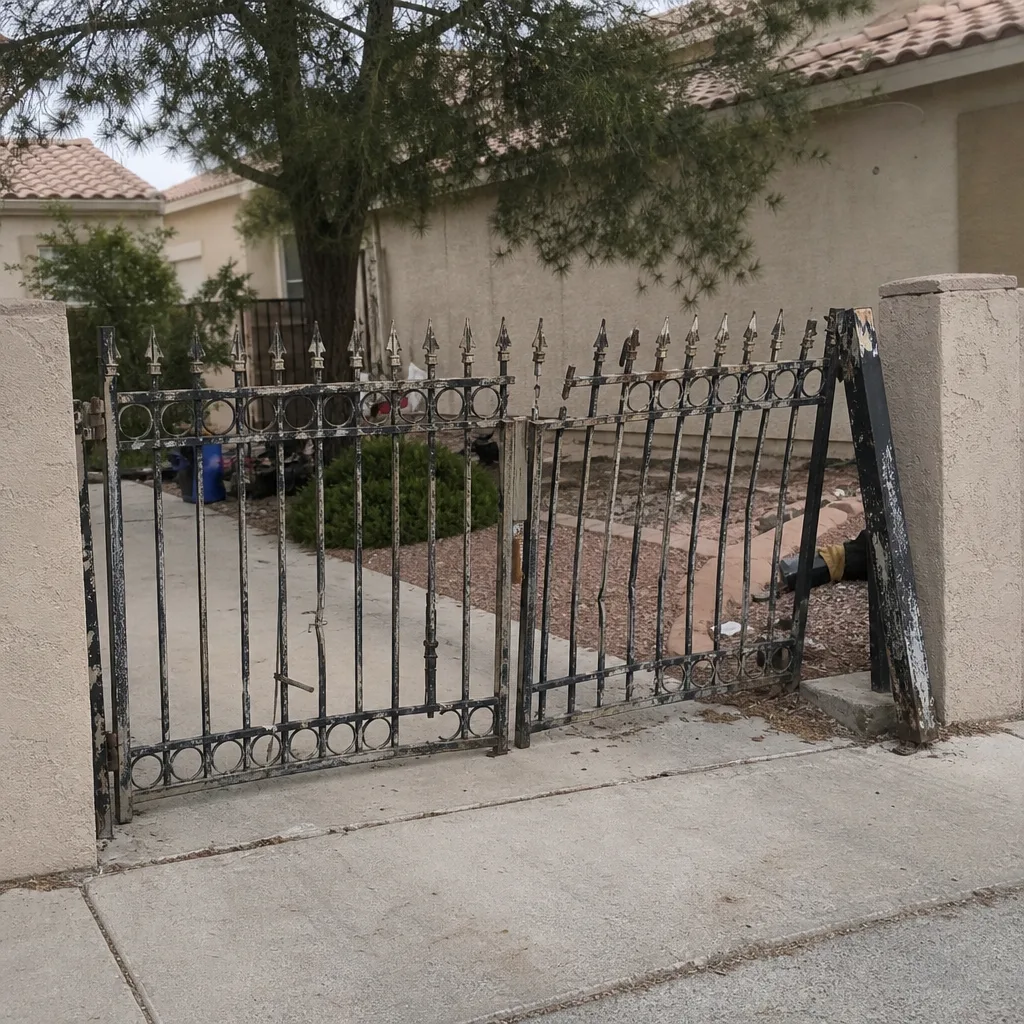 Before
 After
When to Call a Professional
Call a professional the moment a task involves the limits, the force setting, the control board, the wiring, or the motor mount. Also call if your gate reverses suddenly, stops mid-travel, doesn’t respond to the remote, or has been involved in a collision with a vehicle. And call if you’ve started a DIY adjustment and lost confidence halfway through; a technician can verify the setup and test it properly, which is far better than leaving it to chance. Ironworks Gate Co. Summerlin offers free estimates in Summerlin, with upfront pricing agreed before any work starts. Call (866) 623-9848 and a live person will answer, any hour of the day or night.
Frequently Asked Questions
It’s not advisable for most homeowners. The mechanical and wiring work is the part that carries injury risk and typically voids manufacturer warranty, and in Summerlin the heat and dust make correct calibration more important than in milder climates. Pairing remotes and changing keypads is fine to do yourself; mounting the motor and running wiring is not. Call (866) 623-9848 for a free, no-pressure estimate.
Most single-gate opener installations in Summerlin fall in the $900 to $2,200 range depending on the operator, the gate weight, and whether new wiring is required. We quote and agree on the price before any work starts, so the number you approve is the number on the bill. Call (866) 623-9848 for an exact figure.
It often does. Most major opener manufacturers, including LiftMaster and FAAC, condition their warranty coverage on professional installation of wiring and mechanical components. Check the “Exclusions” section of your specific model’s warranty document; if the language is unclear, a quick call to us will sort it out. (866) 623-9848.
In most Summerlin cases, yes. Limit adjustments, force calibration, and sensor realignment are typically single-visit repairs. Call early in the day and you’ll usually get same-day dispatch. (866) 623-9848.
Our $89 seasonal tune-up covers travel limit verification, force testing against the reverse standard, battery health, photo-eye alignment, and lubrication of hinges and rollers. It’s the cheapest prevention available, and it’s the reason our repeat customers in Summerlin rarely face emergency repairs. Call (866) 623-9848 to schedule.
Most likely a sensor, limit, or force setting issue, not a dead motor. In Summerlin, dust on the photo-eye and post-monsoon moisture in the control box are the two most common causes. Don’t adjust anything yourself; call (866) 623-9848 and we’ll diagnose it properly.
The Bottom Line
The line between owner-safe and technician-only work on a gate opener is clear once you know where it sits. Configuration and cleaning on the left; force, limits, wiring, and motor work on the right. If you only need to pair a remote or swap a battery, save the call fee. If the task involves stored energy, calibration, or the warranty on a LiftMaster or FAAC unit, let a technician handle it, because the cost of getting it wrong is measured in thousands, and sometimes in worse. We’re proud to serve Summerlin with upfront pricing, a live person on the phone 24 hours a day, and a written 90-Day Done Right Promise on every job. Call (866) 623-9848 for a free estimate and a square deal.
Written by the team at Ironworks Gate Co. Summerlin.